Blog
How to Control Costs in a Startup: Visibility, Categorization, and Accountability
Fragmented costs, forgotten subscriptions, confused responsibilities: here are 4 concrete best practices to centralize, classify, and monitor recurring costs in your startup, before they become a problem.

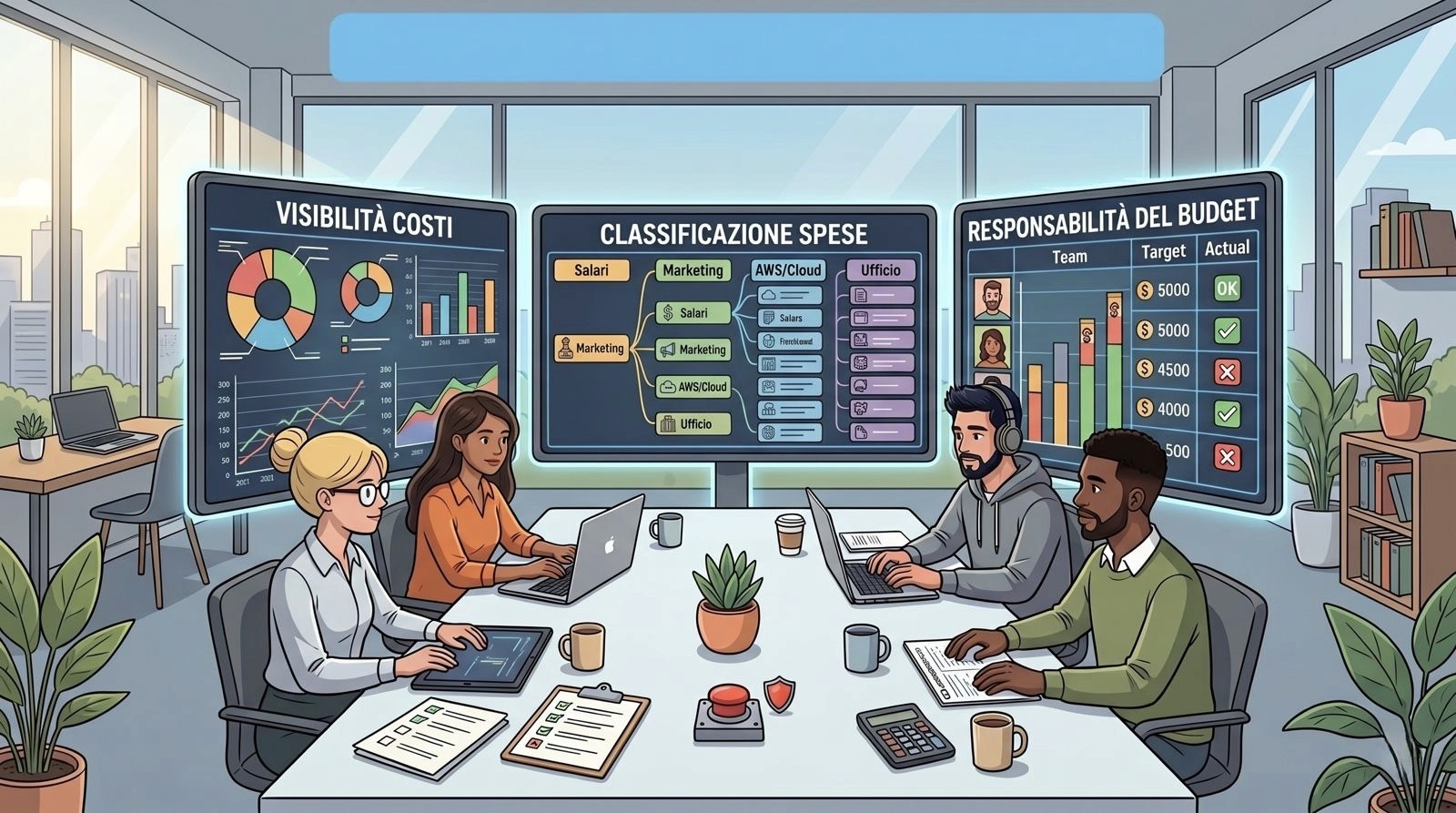
In previous articles, we saw how management control is a fundamental lever for a startup right from the early stages and what risks are run when it is neglected. But when you move from theory to practice, a critical point immediately emerges: cost management.
Because without a precise view of what you spend, everything else loses its effectiveness. And the problem isn't just organizational. Even in already structured startups, it's surprisingly easy to lose control: costs become fragmented, responsibilities get confused, and small, seemingly irrelevant expenses accumulate silently until they become a real burden.
The real problem, therefore, is not so much "controlling costs," but managing to have structured visibility over them. And this is exactly where you need to start.
Best practice #1 — Centralize information
The first step is to see. Having all costs gathered in a single space is the necessary condition to build an overview and make informed decisions.
You might think this task belongs to accounting. In reality, accounting has two major limitations: it is designed for insiders - therefore less immediate for those who have to make operational choices - and it is not in real-time, but always reflects a past situation. This means that many inefficiencies only emerge in hindsight: duplicated costs, uncancelled subscriptions, billing errors that are only discovered when the invoice is recorded, weeks or months later.
For this reason, it is useful to complement accounting with an updated and accessible cost map that allows for continuous monitoring. An effective map does not just list expenses, but makes them readable and analyzable: which areas absorb the most budget, where investments are concentrated, where there is room for optimization.
Centralizing doesn't just mean collecting data in one place, but making it truly useful for decision-makers.
Best practice #2 — Classify costs usefully
Once the data is collected, you must be able to interpret it, and not just by those working in administration or finance, but by all the people making operational decisions.
Accounting classification alone is often not enough. Accounting accounts are created for tax and administrative needs: they tend to aggregate very different items, making it difficult to understand the real weight or purpose of an expense. Under the same "software" heading, fundamental business tools, rarely used tools, forgotten trials, and duplicated services can all end up. From an accounting perspective, they are all equivalent; from a managerial perspective, they have completely different values.
It is therefore useful to introduce classifications built on real business needs, finding the right balance: too generic doesn't help, too granular becomes impossible to maintain. The goal is to make costs readable and comparable, to understand which are generating value and where you can optimize instead.
Among all categories, the hardest to keep under control is often that of recurring costs - licenses, subscriptions, SaaS tools - precisely because they are automatic, distributed over time, and managed by different teams.
Best practice #3 — Monitor recurring costs
SaaS software seems harmless. Yet, even in companies with structured management control, there is almost always some tool that "gets lost along the way."
Unlike more visible costs like employees, rent, or consultants, software renewals are automatic and fragmented: activated directly by teams, paid with different cards, often without a centralized view. The most common problems are always the same: trials started "temporarily" and never canceled, duplicated tools used by different teams for the same task, automatic upgrades due to plan changes or user increases, inactive licenses never removed after an employee leaves.
Today, any company uses dozens of different tools, and it is often difficult to know exactly how many are really active (try it to believe it). Multiplied by teams, users, and months of activation, even costs of 10 or 20 euros a month can quickly become a significant burden.
The main problem is that there is rarely a dedicated moment for periodic review. Even an Excel file or a Notion table might be useful at the beginning, but it hardly holds up over time: by the time you finish updating it, the situation has already changed. Someone activated a new tool, changed a plan, added new users.
It is precisely from this need - born first of all internally - that we developed Kontai. The idea stems from a very concrete problem: finally having a clear, updated, and centralized view of recurring company expenses. Kontai uses artificial intelligence to automatically capture, structure, and connect payments, renewals, licenses, and information related to the software used by the company and all active services, reducing operational chaos and increasing visibility into recurring costs.
Best practice #4 — Define responsibilities and review moments
To prevent recurring expenses from growing out of control along with the company, it is essential to establish ownership and review cadences.
For every active tool, there should be someone able to answer four questions: why it exists, who uses it, how much it costs, and if it is still needed. Without ownership, there is no control, and without control, optimization is very difficult.
In early-stage startups, this responsibility often falls on the founder, CEO, or CFO. In more structured realities, it can be distributed to team managers, while maintaining centralized supervision. The important thing is that it doesn't belong to no one, because the real problem is not the activation of a cost, but its permanence over time: tools are turned on for a real need, then no one checks their usage, utility, or impact on the budget anymore.
For this reason, it is important to include regular review moments in the processes - monthly or quarterly - to check active licenses, the real use of tools, the users still needed, any duplicates, and possible more efficient alternatives.
Cost control should not only happen during moments of crisis. It should be an ongoing activity, integrated into normal management control. Because controlling costs means making growth more sustainable over time.