

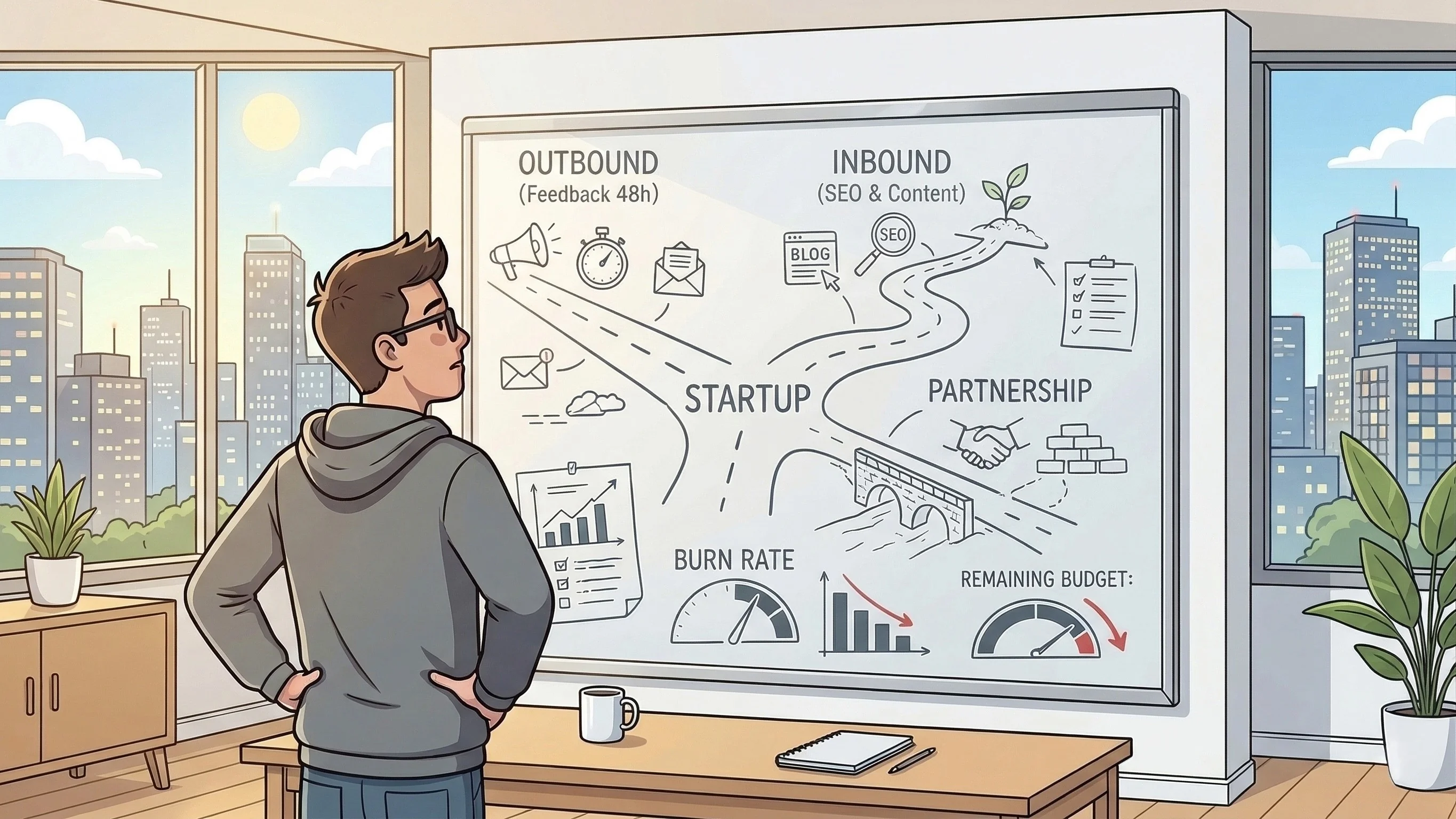
Let’s start from something that happens almost every time: you launch a startup, you have a limited budget (often extremely limited) and the first reaction is wanting to be everywhere. LinkedIn, Google Ads, newsletters, podcasts, content marketing, events, industry fairs. A bit of everything, because “let’s see what works”.
The problem is that this strategy almost always leads to the same result: you spend a lot, you understand little, and after a few months you find yourself with half the budget gone and zero useful data.
Inbound or outbound?
Before choosing the channel, you have to answer a simple question: does your target already know they have the problem you are solving?
If the answer is yes, they are probably already looking for a solution, and an inbound approach (content, SEO, community) can work. If the answer is no, you have to go to your target yourself. Direct outbound, cold emails, calls. It is not the most elegant channel, but at the early stage it is the one that gets you real feedback within 48 hours instead of waiting months for a blog article to climb Google’s results.
This does not mean ignoring inbound completely: using it as a support to outbound makes sense, for example for retargeting activities or to gradually build the brand. It must, however, be dosed with moderation and introduced incrementally, without becoming a distraction from the main goal, which in the early phases is always talking to the market as soon as possible.
At Startup Bakery we have pushed hard on automating the entire outbound process: from lead research and qualification to managing post-call follow-ups. Not to remove the human element from commercial conversations, but to eliminate all the manual, repetitive work around them, freeing up time for what really matters.
In most of our B2B startups, the correct answer remains outbound. Then, over time, you build inbound too. But at the start you need to talk to people, not wait for them to arrive.
The first customers are not there for revenue
There is a distinction that seems obvious but that in practice almost always gets ignored: the difference between an early adopter and just any customer.
The early adopter is not merely someone willing to pay. It is someone willing to use a product that is still imperfect, to report bugs without abandoning you, to tell you to your face what does not work. This figure is worth gold, far more than the contract signed by a company that then never opens the platform.
In the early phases, revenue is almost a secondary indicator. What really counts is having people who use the product, who come back to it and who start talking about it with others. Retention, at this stage, says far more than the number of new contracts.
Partnerships: the channel everyone postpones
Strategic partnerships are the most underrated channel at the early stage. And the reason is simple: they take time. Not weeks, but months and sometimes years.
And yet the reasoning is linear: you find a player that already has a relationship of trust with your target, you build an agreement that makes sense for both, and suddenly you have access to a market that would have taken you years to reach on your own. One to take a hundred, as we often say.
The advice is to start working on partnerships right away, even when the product is still unripe, precisely because the time it takes to build a solid commercial relationship cannot be compressed. If you wait for the product to be “ready”, you find yourself starting this work six months late.
Structured agreements with distributors or resellers are a different matter: there you need a mature product, a clear sales process and the ability to manage an indirect channel without losing control over quality. It is a powerful instrument, but it must be activated at the right moment.
Smart money: the investor worth double
If you are looking for investors, don’t look only for capital: look for people with a real network in your industry.
An investor with the right relationships can open doors that would require years of commercial work. It is not just a matter of money: it is a matter of who they know, of who can introduce you and of how quickly you manage to get in front of your potential customers. In some cases, a single investor with the right network is worth more than a hundred-thousand-euro campaign.
Remember, the investor must be your first sponsor.
Conclusions
There is no perfect channel in absolute terms. There is the right channel for your target, for your problem and for the moment your startup is in. Finding it requires a few mistakes, that is inevitable, but the goal is to make few of them and make them fast, without burning everything before understanding where you are going.
###
Startup Bakery is the Italian startup studio specialised in creating B2B SaaS companies with Artificial Intelligence. We offer aspiring Co-Founders the opportunity to develop a business idea. We create investment opportunities for Professional Investors. We help companies in their innovation process.