

In previous articles we saw how management control is a fundamental lever for a startup from the earliest phases, and why having visibility on costs is the first step towards making more conscious decisions. But when you move from reading the numbers to operational management, another central theme emerges: cash flow.
Because having a budget matters. Knowing how much you plan to spend, which revenues you expect, which costs have been incurred and where there are deviations from the plan is fundamental. But for a startup this is not enough. The real point is not just understanding whether costs and revenues are in line with the budget, but understanding how those numbers impact the cash. In other words: it is not enough to ask “are we sticking to the plan?”, you have to ask “is this plan financially sustainable over the coming months?”.
This is where cash flow becomes an operational metric. Because it translates budget, actuals, collections, payments, taxes, financing and capital into a very concrete question: how much cash do we have today, and how much will we have in the coming months?
From the economic budget to the cash view
In our case, the main management control tool is still an Excel file. Yes, an Excel file: because, at least for now, we have not found a solution that truly fits our way of working and the specific needs of a startup in constant evolution.
This file is built on two main views: an economic view, made up of budget and actuals for revenues, costs and staff, and a financial view, dedicated to cash flow.
The budget part is fed at the start of the year with a forward-looking forecast of costs and revenues. But it is not a fixed document, to fill in once and then leave there. On the contrary, it is a dynamic tool. Every month we review the budget to understand whether operational needs have changed, whether new costs have emerged, whether some investments should be brought forward or postponed, or whether there are new revenues to add to the forecast.
The budget is then compared with the actuals. This lets us see the deviations between what we had forecast and what actually happened: costs higher than expected, revenues below or above expectations, new expenses not initially considered. And it is exactly here that an important part of the control is born: understanding where we spent more, where we spent less and, above all, why.
But this economic reading, on its own, is not enough.
Everything must talk to the cash flow sheet. This view is fed with the actuals of collections and outflows recorded on the bank account and updated month by month. For the months ahead, instead, the cash projection is built starting from the budget data.
This step is fundamental, because it lets us see immediately how every change to the budget affects the prospective cash. If we add a new cost, if we bring an investment forward, if we forecast a new revenue or postpone an expense, we are not simply updating a number: we are verifying the impact that decision will have on the liquidity of the following months.
In essence, budget and actuals help read the company’s economic situation. They serve to understand whether costs are under control, whether revenues are going in the expected direction and whether there are deviations to look into. But they are not enough to understand real liquidity.
The economic figure becomes truly useful when it is connected to the cash. Only then is it possible to understand whether a decision is sustainable in the following months: hiring a new person, activating a supplier, bringing an expense forward, postponing a payment or managing an investment.
That is why, in our way of working, the budget is not just an economic forecasting tool. It is the starting point for building a more concrete financial vision: the one that tells us not only what we plan to do, but whether we have enough cash to do it.
Knowing how much is not enough: you need to know when
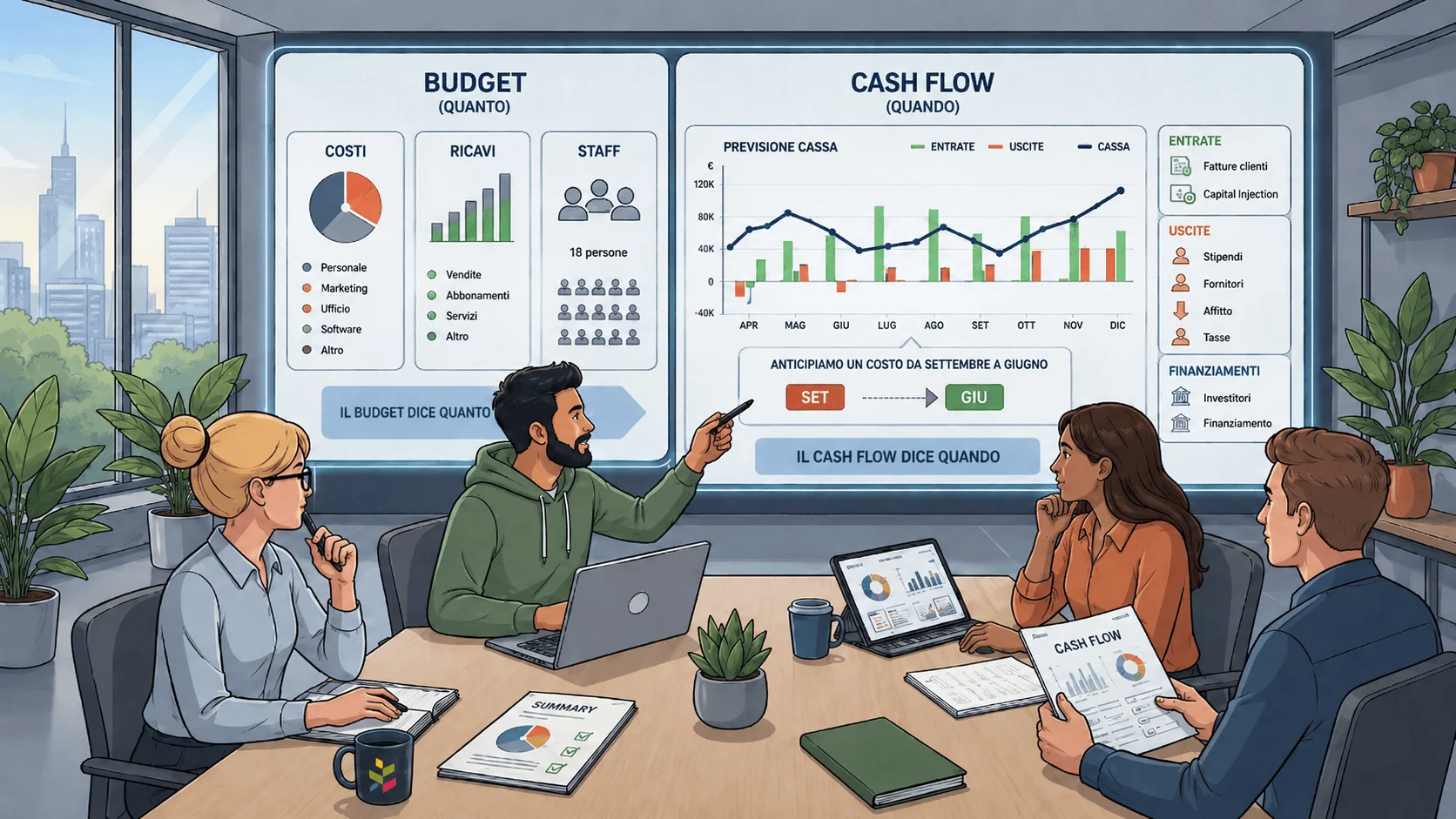
There is, then, an important difference between budget and cash flow: the budget tells us “how much”, the cash flow tells us “when”.
And this is exactly why not everything can be reasoned about only in terms of costs and revenues. Costs and revenues are fundamental for reading the company’s economic performance, but they do not always coincide with payments and collections. An invoice can be issued today and collected in two months. A cost can be budgeted in one period but paid at a different moment. An expense can slip, a collection can be delayed, an investment can be brought forward.
Take a simple example: in the budget we forecast the cost of a new supplier in September, for 10,000 euros. For operational reasons, though, the need emerges to bring it forward to June.
At the level of the overall budget, the annual total does not change: we take 10,000 euros out of September and move them to June. The final balance of the budget stays the same. But from the cash point of view everything changes.
Bringing that cost forward by three months means having a financial outflow earlier than expected. So the question cannot just be: “is this cost in the budget?”. The correct question becomes: “if we bring it forward, what impact does it have on the cash of the coming months?”.
We might discover that, economically, the cost is sustainable, but financially it is not. Perhaps because other significant payments are already scheduled at that moment, because some collections will slip to the following month, or because we want to maintain a certain minimum threshold of available liquidity.
The real question, then, is not just “can we afford this cost?”, but “when does it hit the cash?”.
Moreover, if you only look at the economic plan, you risk missing an important part of the picture. There are movements that do not pass directly through the income statement, but that significantly affect liquidity: tax payments, debts towards the tax authorities, financing received or repaid, capital injections, investments, grants or other extraordinary operations.
These are items that may not change the economic reading of the budget the way a cost or a revenue does, but they can significantly change the cash availability.
That is why cash flow becomes the bridge between the economic plan and the day-to-day management of liquidity. It lets us read decisions not just for their overall value, but for their impact over time. Because in a startup it is not enough for the plan to “add up” at the end of the year: it must be sustainable month by month.
Cash flow as an operational metric
If the budget helps us build the plan and the actuals let us verify what happened, the cash flow helps us decide what we can do.
That is why, in the daily management of a startup, the cash view is not just a financial report, but an operational tool. It serves to understand whether a decision is sustainable not just “on paper”, but in the months that follow.
The point is not to block decisions, but to take them with greater awareness.
Having an up-to-date view of the cash flow makes it possible to understand what room for manoeuvre there is, which months could be more critical and which actions can be managed in advance. In a startup, where priorities change quickly and operational needs can evolve month after month, this visibility becomes fundamental.
Cash flow, then, does not serve only to check the cash available today. It serves above all to build a forward-looking view: understanding how much cash we will have in the coming months, which commitments have already been taken and how much room we have to sustain new decisions.
In this sense, cash flow transforms the budget from a forecasting document into a management tool. It does not just tell us what we had planned: it helps us understand whether that plan is still sustainable, whether it needs updating and what effects it produces on future liquidity.
Conclusion
For a startup, having a budget is fundamental: it helps plan costs, revenues and goals. But the budget becomes truly useful when it is connected to the cash flow. Because it is not enough to know how much you plan to spend or invoice. You need to understand when the money will come in, when it will go out and how much cash will remain available in the following months.
The budget tells the economic direction. The cash flow tells us whether that direction is sustainable.
And that is why cash management is not a topic separate from management control, but a central part of it. In a startup, growing does not just mean having an ambitious plan: it also means having enough liquidity to sustain it, month after month.