

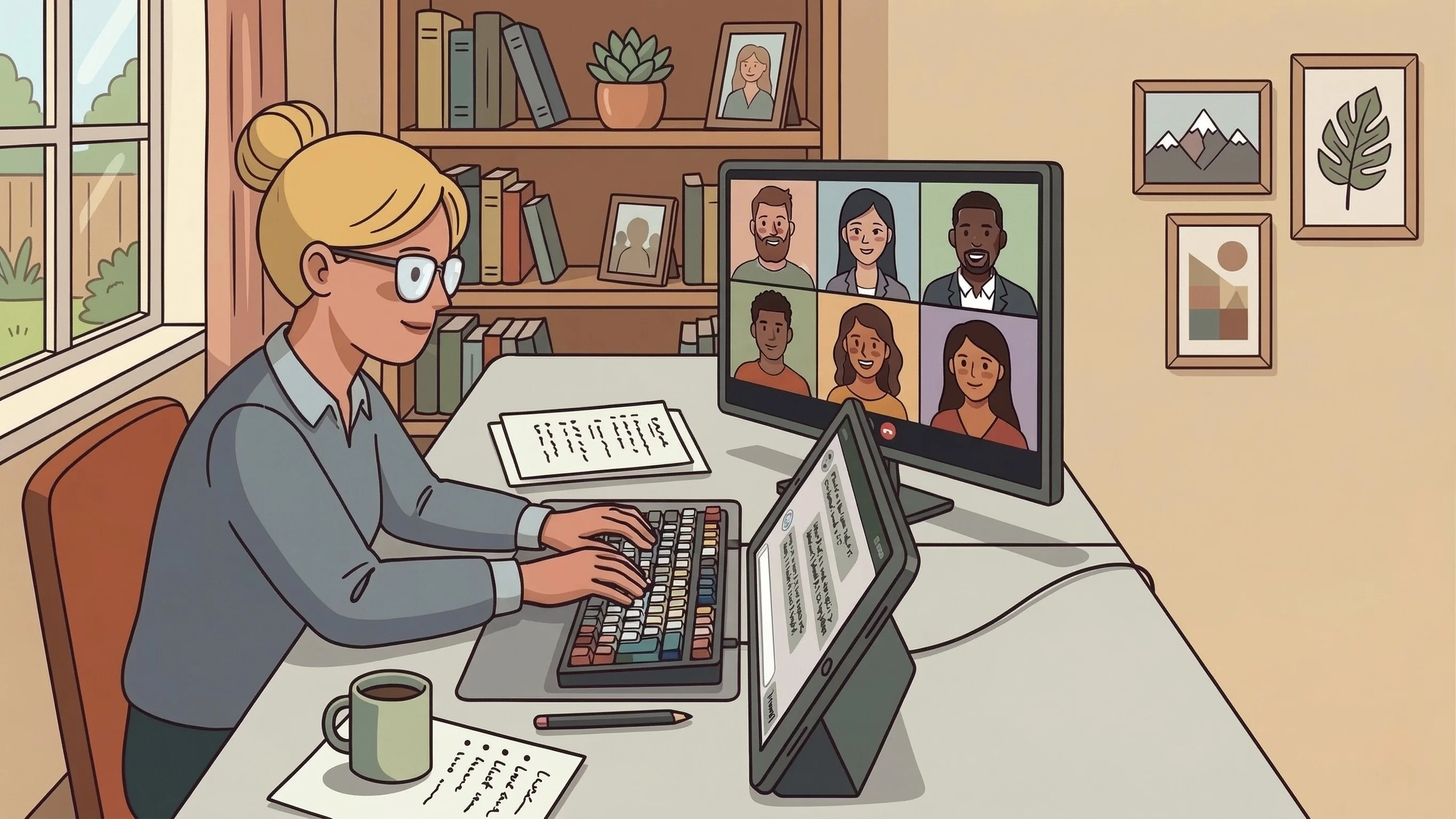
For a startup, deciding how to work is a strategic choice as much as deciding what to build or which market to aim for. Remote work is not just an organisational model: it is a cultural statement.
Adopting a 100% remote approach means moving from a system based on physical presence to one founded on responsibility, autonomy and results. In this scenario, the office stops being an obligation and becomes a space of choice, an optional hub that does not bind talent to geography. Working remotely makes it possible to draw on a global pool of skills, placing trust, instead of control, at the centre of growth.
When remote is the right choice for a startup
Remote is not the solution to everything, but it can be a choice that helps give structure to the organisation and, precisely for that reason, make it paradoxically more solid and orderly. No, it is not a fad.
For remote work that works, some fixed points must be in place:
clarify the roles;
make responsibilities explicit;
define and measure the goals.
In other words, it works when the company does not rest on improvisation. And in this context, our organisational model based on holacracy comes to our aid, distributing authority and responsibility instead of concentrating them in a traditional hierarchy. Decisions do not all pass through a single level, but are taken by those who have the role and the skills to take them, in a context where trust replaces control and autonomy comes with responsibility.
Teams and roles best suited to remote work
In many companies people tend to say remote works better only for some roles: tech, product, marketing, design. But shifting perspective, there is an important point: it is not the role that determines whether remote works, it is the way the organisation is designed.
Being a startup studio that mainly develops software products and services, at Startup Bakery every role can be performed remotely. Not just the technical ones, but also HR, operations, finance, marketing, leadership. Our work is digital by nature and physical presence is not an operational prerequisite.
Not to be underestimated, moreover, is that remote allows companies to draw on an infinite pool of candidates without any geographical limitation.
Remote-first vs hybrid: operational differences
Many companies choose a hybrid model thinking it is a balanced compromise. In reality, it can generate asymmetries: those in the office have more access to information, more informal context, more influence.
That is why we consider a remote-first approach more solid: even if an office exists, processes are designed to work independently of physical presence. The office thus becomes a “voluntary” space for relationships and collaboration, not the centre of the system.
Pros and cons to weigh before adopting it
Remote is an opportunity that demands autonomy, discipline and the ability to organise by priorities. Not everyone feels at ease in this model, and not every company is ready to sustain it.
But for a startup that wants to build a culture based on trust, responsibility and results, remote can be a deeply coherent choice.
The question is not “does remote work?”. Rather: is our organisation designed to work even without physical presence? If the answer is yes, remote is not a risk. It is an accelerator.
The pillars of effective remote work
Over time we have understood that remote only works if it rests on some very concrete pillars.
Well-defined processes and responsibilities
One of the main sources of friction in remote is ambiguity. If it is not clear “who does what”, distance amplifies the problem. At Startup Bakery we work with very explicit roles and responsibilities, inspired by a holacratic organisational model. This means every person knows which decisions they can take autonomously, which goals they are measured on and what their priorities are.
A culture of trust and accountability
Remote cannot coexist with micromanagement. If control is based on hours online or presence in calls, the model breaks. Trust, though, is not naive. It rests on punctuality, keeping commitments, transparency about difficulties. It is a mutual pact: autonomy in exchange for responsibility.
Clear communication (synchronous and asynchronous)
When you do not share a physical space, words weigh more. You have to learn to distinguish between what should be discussed in a call and what can be written in a structured way. Calls serve to decide, to confront each other, to untangle complex knots. Async serves to update, document, share. Writing well, summarising, giving context: these are key skills in a remote team.
Centralised documentation
Closely linked to the point above, documentation is not bureaucracy: in a remote team it becomes infrastructure. Every process, decision and guideline must have a shared space. This reduces dependencies, speeds up onboarding and makes the team less fragile.
Operational best practices for distributed teams
Beyond the principles, concrete rituals are needed.
Recurring rituals (weeklies, retros, all-hands)
Team weeklies, periodic retrospectives and all-hands moments help maintain alignment and a common vision. It is not about filling the calendar with calls, but about creating appointments that give the work a rhythm.
Guidelines for effective meetings
Every meeting should have: a clear goal and a shared agenda. If one of these elements is missing, it is probably not a necessary meeting.
Structured remote onboarding for new joiners
Onboarding is one of the most delicate moments. In remote, improvisation does not work. You need a plan for the first weeks, a point of reference, accessible documentation and frequent check-in moments. The goal is not just to transfer information, but to make the person feel part of a system.
Moments of alignment and socialising
Human contact should remain important, even in a 100% remote model. That is why it is important to organise occasions to meet that are not purely operational: off-site moments, informal team-building gatherings. Relationships do not happen by accident: they must be designed, above all when you do not share the same space every day.
Common mistakes to avoid
Working with distributed teams, some mistakes tend to come back cyclically. One of the most widespread is filling the days with calls in an attempt to compensate for physical distance, a remedy that often makes things worse, leaving little room for actual work. Also ineffective is not documenting the decisions taken: without a written trace, information gets lost and misunderstandings multiply.
Another risk is adopting too many tools without defining clear rules on how to use them, creating confusion instead of efficiency. Added to this is the tendency to set vague goals, which make it hard to measure progress and keep motivation up. Finally, there is a subtler but equally serious mistake: neglecting people’s wellbeing and engagement, which at a distance require even more conscious attention.
It is worth remembering: when people say “remote doesn’t work”, in most cases the problem is not the distance itself, but the lack of clarity, in processes, in expectations, in roles.
Essential tools for working remotely
A special mention, finally, goes to the right tools, which remain fundamental for easing everyone’s work and making the principles above simple to respect. Here are our recommendations:
have a well-organised team chat, and Slack for us is a lifesaver;
use effective video call tools such as Google Meet;
identify project management tools to assign tasks, define priorities and set roadmaps, we use Notion and Jira;
a centralised space for documentation.
Beyond the organisational principles, there are concrete tools that can ease everyone’s work and make the principles above simple to respect. For asynchronous communication, a well-structured team chat is essential. We use Slack and would hardly go back. For video calls, Google Meet has proven reliable and effective, without needless complexity.
On the project management front, having a dedicated tool to assign tasks, define priorities and build roadmaps is indispensable: in our case, the combination of Notion and Jira covers both operational and strategic management. To all this is added a centralised space for documentation, which represents the team’s collective memory and the point of reference for anyone needing to find their bearings.
Conclusions
If goals are reached on time, people feel involved and responsible and the quality of the work stays high, then remote is a genuine competitive advantage. It should not be considered a perk but a strategic and structural choice.
At Startup Bakery we chose a remote-first model because it is coherent with our principles: autonomy, respect, lean culture, continuous learning and quality.
The point is not working from home. The point is building a system in which people can give their best, wherever they are. And for a startup, this can make all the difference.