

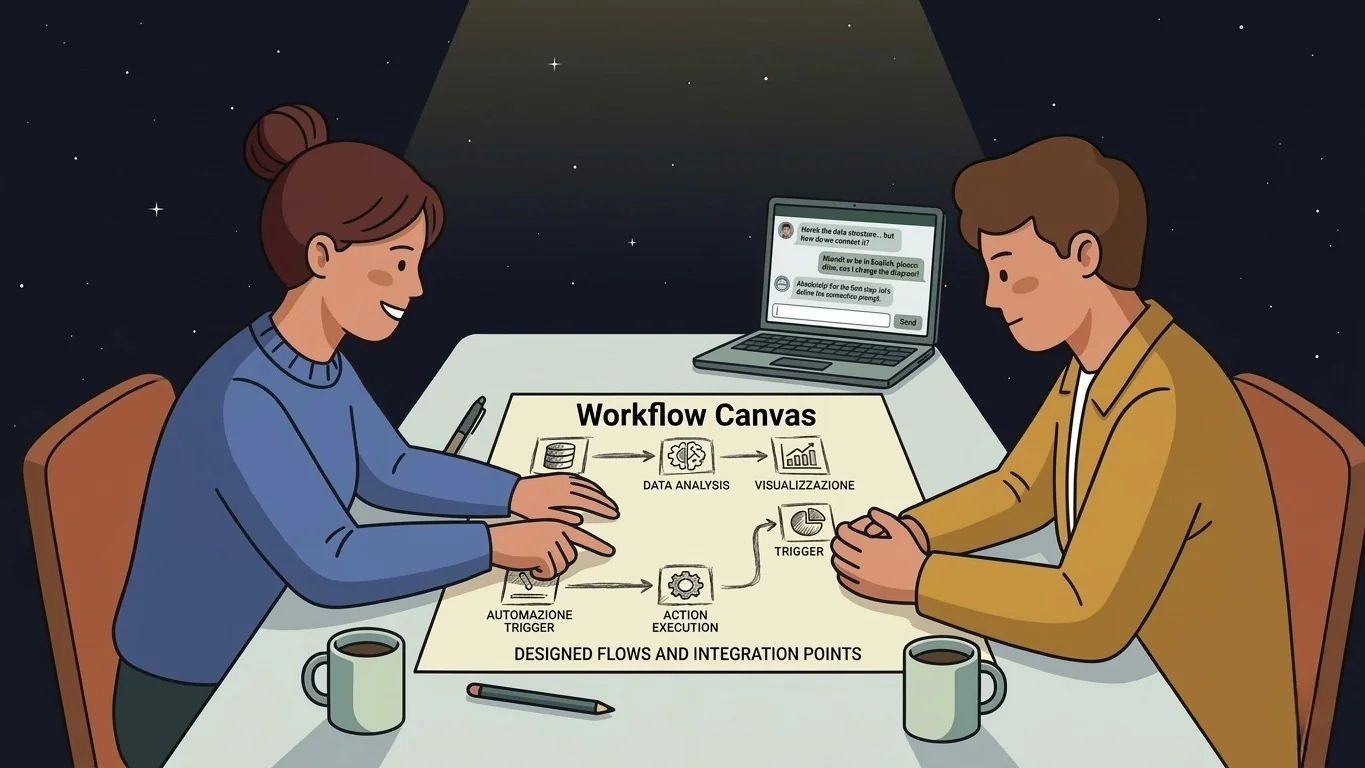
There is a sentence that comes up again and again in startups: “We’ll think about automation when we’re more structured.”
It is an understandable position. When a team is small, processes change fast and priorities chase each other, the idea of automating becomes something to put off until later.
The problem is that this “later” often arrives too late. And in the meantime the team gets used to working in permanent emergency mode: activities handled by hand, steps entrusted to memory, time scattered on operations that generate no real value.
Automation is not a tool reserved for companies that are already structured. On the contrary: it is precisely in the early phases that it can make the difference, because it helps protect the scarcest resource a startup has, time.
What automation really is
When people talk about automation, many still think of complex projects and technology stacks, or out-of-scale investments. In reality, in most cases, automating means doing something very simple: taking the friction out of what the team already does every day.
It is not about replacing people. It is about preventing them from spending hours on repetitive, predictable, low-impact activities. Entering data or moving information from one tool to another: these are all necessary operations that should not consume the team’s precious energy.
Automation, used well, does not make work colder. It makes it more focused. It frees attention for what requires judgement, relationships, sensitivity and creativity. In other words: for everything that cannot be reduced to connecting point A to point B.
When automating makes sense
The right question to ask is: “is this activity already costing us too much time?”, not whether you are ready.
The signals are usually quite clear:
you repeat the same activity every day or every week;
the process runs through too many tools or too many manual steps;
the team spends more time on operational management than on strategic decisions;
mistakes don’t come from incompetence, but from the fact that too many things still depend on someone’s memory or attention.
This does not mean everything should be automated at once. If a process runs rarely, if it is not yet clear or if it keeps changing, automating it risks stiffening something that is still being defined. First you observe, then you simplify, and finally you automate.
Where to start
When you begin, the temptation is almost always the same: wanting to do and redo everything at once. But the first step is not automating more. It is understanding better how your company works today.
For an early-stage startup, the most useful starting point is almost always the operating structure. You need to look at the real processes: analyse how information circulates, where it stops and at which points manual work is still compensating for a fragile system.
That is why the first genuinely useful automations are not always the most visible ones. They often concern the way tools and people collaborate: a cleaner sync between CRM, project management and internal channels, the centralisation of requests and approvals currently scattered between chats and emails, or flows that make clear who takes charge of what and when.
Another fundamental step is reducing the dependence on “tribal” knowledge, those situations where a process works only because there is someone who knows how to keep it going. If every step depends on the memory or experience of a single person, the system risks collapsing.
That is why, especially at the beginning, you need to bring order. Clarify responsibilities, eliminating useless steps, which makes the work more legible. Only afterwards does it make sense to figure out whether to optimise the existing tools or replace them with something more suitable.
Automating with intention, without losing uniqueness
Today automating is easier and easier. And with the spread of AI it will become even more so. This is a huge advantage, but it also carries an often underestimated risk: the more accessible the tools become, the more ways of working tend to converge.
Emails, follow-ups and content start looking alike. And, little by little, processes too begin to replicate standardised models. The risk, then, is not just conforming to others: it is becoming interchangeable.
That is why automation should always start from a deeper question: why are we automating this? To speed up a process, reduce errors and give quality time back to the team? Or just because today it is possible?
The distinction matters, because a startup does not build value through speed alone. It builds it above all through vision, quality of relationships and the ability to be recognisable. Automating must not mean thinking in silos, nor turning every interaction into an impersonal sequence.
An automatic follow-up can make perfect sense. But it cannot be the thing a relationship stands on by itself. Today everyone can send automatic emails, generate content in seconds and make processes more efficient. Far fewer, though, manage to do it without impoverishing the relationship with customers, candidates, partners or the team.
This is exactly where the difference will play out: not in using automation and AI, but in doing it without sacrificing what makes a company genuinely recognisable and human.
The right approach prevents the mistake
When automating, the most common mistake is starting from the solution instead of the problem. You end up making a process faster when it should first be simplified, or freezing into a scenario something that is still too unstable to be truly automated.
Complexity too, especially at the beginning, is often a false signal of maturity: the more elaborate a flow is, the more fragile it becomes to maintain.
That is why automation only works when there is clarity upstream. You need to know what you want to obtain, why that process exists and who takes care of it over time. Even the best flow, without ownership, risks degrading quickly.
The same goes for choosing tools. There is no need to chase the most complete or sophisticated platform, but the one best suited to the phase the company is in: easy to use, integrable with what already exists and solid enough to sustain growth without adding friction. The point is not automating more, but automating better.
A simple example is handling inbound leads. It makes sense to automate the intake into the CRM, the internal assignment or a first reply. But the value is not in the automatism itself: it is in the fact that, by eliminating the technical and repetitive steps, the team can concentrate on the part that really matters, that is, understanding the need and building a relationship.
How we work on automation at Startup Bakery
Our work always starts from a simple question: where is time, clarity or continuity being lost? From there we analyse how a flow really works, identify the steps that slow the work down and intervene to make it more linear, solid and sustainable.
It is a method we apply both inside our own companies and together with the companies we collaborate with. We are not interested in adding complexity or multiplying platforms: we are interested in building an ecosystem that sustains growth, lightens day-to-day operations and leaves more room for the decisions that matter.
For us, then, automation does not coincide with switching on a sequence. It is a work of design, simplification and grounding. First you clarify how the whole works, then you choose the most suitable solutions, and only at that point do you build something that can truly accompany the evolution of a team or a company.
The future is staying recognisable
As tools and automations become more and more accessible, doing things efficiently will be less and less a distinguishing trait. The real difference will lie in everything that keeps carrying a human imprint: the tone, the judgement, the sensitivity, the way relationships are built and even certain imperfections that make a piece of work alive and recognisable.
That is why the point is understanding what is worth lightening and what, instead, must remain deeply human.
Because if efficiency will be easier and easier to reach, staying recognisable will be much less so. And that is where the real challenge will play out: using automation not to replace human value, but to put it even more at the centre.
###
Startup Bakery is the Italian startup studio specialised in creating B2B SaaS companies with Artificial Intelligence. We offer aspiring Co-Founders the opportunity to develop a business idea. We create investment opportunities for Professional Investors. We help companies in their innovation process.