

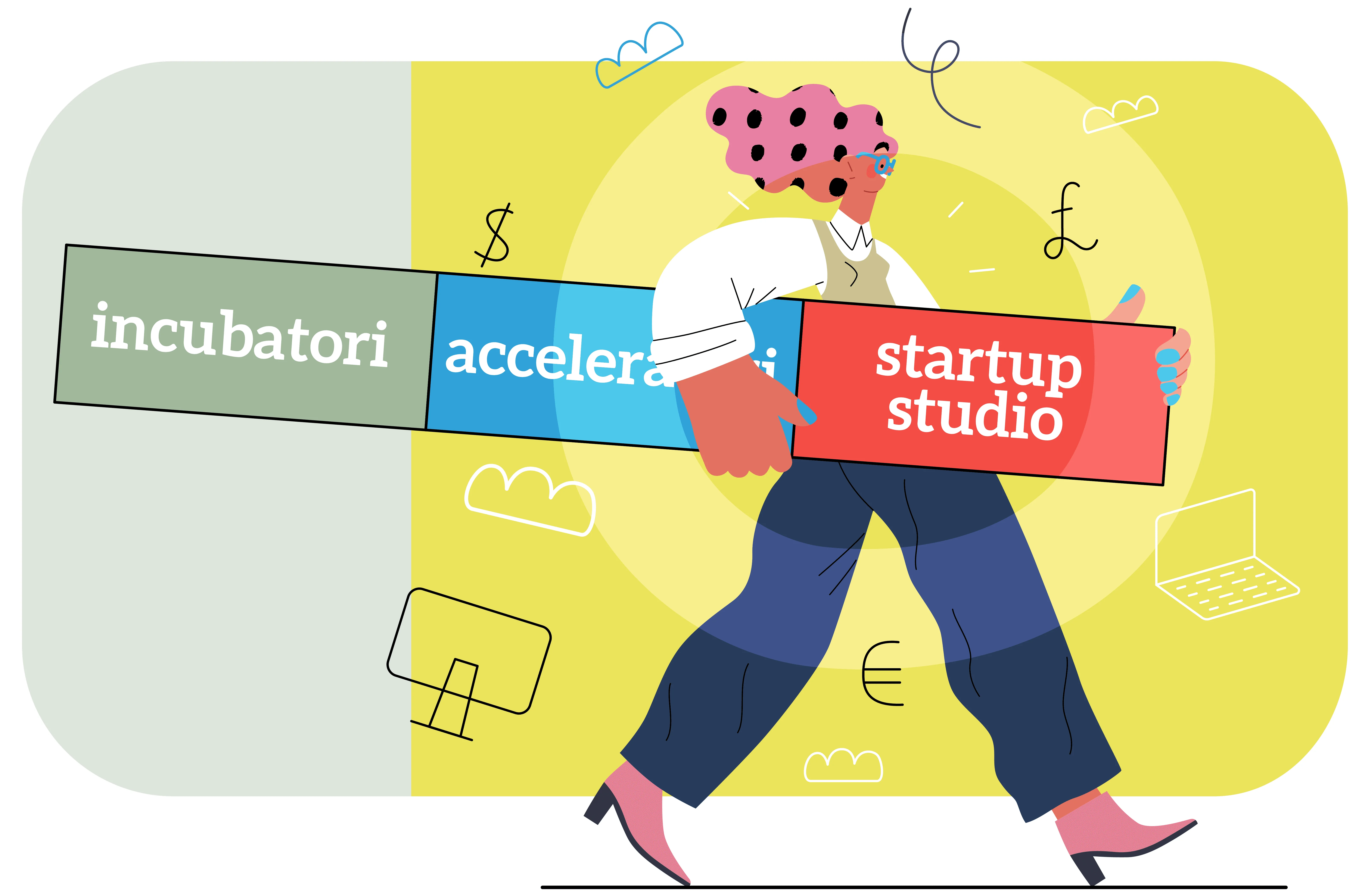
The startup studio model is gaining ground in Italy too. Not only are many new startup studios being born, but various accelerators and incubators have also begun expanding their activities by creating startup studios of their own.
The growth of the Studio community is without doubt an excellent thing, and the valid, promising new organisations being born help make the model ever better known, understood and appreciated by investors and partner companies.
But as inevitably happens when a new model reaches critical mass, among the many “genuine” initiatives there is always someone who, through excessive simplification if not outright malice, presents as new what is not new, just to ride a trend. It is not rare to run into presumed startup studios that, on closer inspection, would be better described as accelerators, incubators or consulting services.
Not that the contribution of accelerators, incubators and consulting services is any less useful to the innovation community, quite the opposite! But it is good not to muddy the waters, and to distinguish one approach from another.
So how do you tell startup studios apart from accelerators or incubators? And above all, real startup studios from presumed ones? Here is a mini-guide with an explanation of the three models and of the fundamental differences between startup studios, accelerators and incubators, which will help you tell them apart and unmask any impostors!
What incubators, accelerators and startup studios are
How they work and when they come into play
How they increase a new venture’s chances of success
What the goals of incubators, accelerators and startup studios are
How they earn and how their revenue models differ
6 questions to tell whether it really is a startup studio
What incubators, accelerators and Startup Studios are
First of all, some definitions.
What is a startup incubator? An incubator is an organisation that supports startups during the early phases of their development: besides offering consulting services ranging from training to mentoring to networking, incubators typically offer startups a physical place to work in. A startup can be hosted for varying lengths of time. Incubators generally charge a fee, but some also take equity in the startups joining their programme.
What is a startup accelerator? An accelerator is a programme that aims to accelerate the development of a new venture and addresses startups that have already been created. An acceleration programme is generally structured around a “curriculum” of advisory support for founders across various entrepreneurial activities, in exchange for a percentage of equity. The goal is to make the selected startups take a leap in quality, making them attractive to Venture Capital or steering them towards an exit. Many accelerators also offer financial resources and the use of physical spaces during the programme, but that is not the defining trait of their offering.
What is a startup studio? The Startup Studio is a “startup factory”, a true serial generator of new ventures that founds and builds new companies in series following a “parallel entrepreneurship” approach: the studio acts as a “serial founder”, founding several startups “in succession” and taking them to growth (and to the exit) “in parallel”, thanks above all to its own resources, both economic and financial as well as internal expertise. Playing the double role of “creator” and “investor”, in many respects a startup studio is like a Venture Capitalist investing in “self-generated” underlying assets.
How incubators, accelerators and startup studios work, and when they come into play
Incubators, accelerators and startup studios step in at different moments, and for different lengths of time, in the startup’s life:
Incubators accompany the founder, who has already incorporated the startup (or is about to) on the basis of a business idea, to the creation of the Minimum Viable Product and to a first articulation of the basic company processes, helping the new company make a journey often described as “from zero to one”. You can be selected by an incubator at any time of year, and this depends above all on the incubator’s available resources and space. Participation in an incubator has no predefined duration: it depends above all on the startup’s ability to structure itself and take this first step, as well as on the founder’s ability to cover the membership cost.
Accelerators step in at a later phase than incubators: to be selected for an acceleration programme, a startup must already be sufficiently formed and have taken its first steps. The accelerator’s engagement works as a “launch ramp” allowing the startup to develop further, obtain its first business results and prove to Venture Capital and other potential investors that it is a promising opportunity to bet on. If selected, you enter an acceleration programme at set moments and for a more or less fixed duration, that is, the time needed to complete the “curriculum” defined by the accelerator, culminating in the search for qualified investors.
Startup studios begin much earlier than incubators and accelerators. If it is true that incubators help the startup go “from zero to one”, startup studios begin from moment “minus one”, that is, from the research, selection and validation of the idea. The startup does not exist yet and, unless the idea proves promising according to objective criteria, it might never exist at all. In a sense, you don’t “get into” a Startup Studio: you only come out of it.
How do they increase a new venture’s chances of success?
Incubators, accelerators and startup studios provide different answers. Unfortunately, most startups fail, and this is a fact that incubators, accelerators and startup studios must reckon with. The three models try to answer the need to increase every new project’s probability of success in different ways.
Incubator: Those who want to create a company do not always have the right skills to do so. In fact, in most cases founders probably have no entrepreneurial experience behind them. The incubator therefore sets out to increase the new startup’s chances of success by “immersing” the founders in an environment (also in the physical sense) that fosters innovation, contact and cross-pollination between different startups, and by providing training, advisory support and services.
Accelerator: The accelerator’s strategy consists of identifying the most “promising” startups and helping them “accelerate” their growth path through a staged programme culminating in the presentation to potential investors. Unlike the incubator, the accelerator stands “closer” to the startup, also by virtue of the stakes it holds. The accelerator therefore sets out to increase the chances of success of the startups it invests in first of all through a selection process, and then by providing resources (financial, as well as advisory) and pointing the startup along a path to follow to make the “leap in quality”.
Startup Studio: The startup studio model rests on the conviction (and, statistics in hand, it is practically a certainty!) that providing training, skills and resources to a startup that is “already created” is often not enough to increase its chances of success, and it tries to go “upstream” of the problem by stepping in before the startup has even been founded. The reasons a startup can fail are many, ranging from operational problems (insufficient skills, experience, resources and systems) to “cognitive” dynamics, such as many founders’ inability to recognise that their idea does not work and to “pivot” before it is too late. The startup studio first of all sets up an operating machine (made of resources, procedures and a team of serial entrepreneurs) able to carry out most of the activities needed to create a company. The studio’s team then moves on to selecting and validating possible business ideas, and creates a new startup only when certain objective signals are reached. Only at that point does it select the co-founder and the team best suited to run the project. In other words, instead of helping an already created startup face its operational challenges and find its market positioning, the startup studio sets out on one side to solve, from the start, most of the implementation needs that typically hinder a new startup’s journey, and on the other to verify from the outset that a business idea can win the market’s favour. Only then does the startup studio found the startup and stand by it all the way to the exit.
What the goals of incubators, accelerators and startup studios are
Simplifying a bit (or perhaps quite a bit), one can say that the main goals of these three organisations are fairly different.
Incubator: creating the MVP and the business plan Coming into play in the initial phase of company creation, the incubator generally accompanies the new startup to the creation of its MVP (if it does not have one already) and of a business plan. The advisory support the incubator provides thus aims to ensure the new venture is based on a product and a plan that are sustainable, or at least viable.
Accelerator: KPIs and Demo Day As the word itself says, accelerators accelerate the startup’s growth, and that growth must be quantifiable, so the emphasis is on reaching KPIs and building numbers that prove the startup is a good investment. The advisory support provided helps the startup structure itself better, “scale”, and accompanies it towards a Demo Day, an event where all the startups of the same “class” present their “pitch” to investors and Venture Capital funds.
Startup studio: exit Coming into play even before the incubator and accompanying the startup up to a fairly complete structuring, the startup studio also does many of the things done in an incubator or an accelerator, from the business plan to the MVP, to the pitch with business KPIs. The startup studio’s final goal, however, is the exit, that is, the sale of its stakes to an investor or a corporate.
How incubators, accelerators and startup studios earn, and how their revenue models differ
All three provide services to startups and, of course, nobody works for charity. And although all three business models can include both an “equity” investment and a “fee” compensation, they are fairly different in their definitions of success.
Incubators: Incubators earn mainly on the basis of a fee and, as long as the startup manages to cover this charge, it can obtain both advisory support and a physical space to operate in, alongside operational services. An incubator’s success is therefore mainly tied to the duration of the services provided, even more than to the success of the individual startups. Obviously, though, an incubator’s reputation and standing depend on the success of the startups it hosts.
Accelerators: Above all at the international level, the large accelerators invest in startups in exchange for equity, but you often come across accelerators that also demand a fee in exchange for their services. Although there is no single rule, in most cases an accelerator succeeds if the startup’s valuation increases at the end of the acceleration path and if investors or Corporate Venture funds join the capital.
Startup Studio: The startup studio is the founder and first investor of the startups it creates, so, even more than for accelerators, the success of startup studios is tied to the success of the startups created.
How to recognise “real” startup studios

Given that there are no universal criteria and every organisation sets its own rules, here are some questions that can help you distinguish startup studios “properly so called” from other kinds of organisations:
Does it address startups that are already formed?
If the answer is yes, then it is decidedly not a startup studio. The startup studio creates startups from scratch.
Does it invest directly in the startups?
If the answer is no, then it is not a startup studio. The startup studio is the first investor of the startups it creates.
Does it help startups grow, or does it create them?
If it limits itself to helping and supporting startups in their growth, it is probably an accelerator or an incubator. It is a startup studio only if it creates startups from scratch.
Is the offering mainly advisory?
If the answer is yes, then it is not a startup studio. The startup studio’s team also supports the startup through advice but, above all in the initial phase, the studio’s team is in practice the startup’s team. Advice is secondary.
Is it open to anyone who wants to become a founder, and does it charge a fee?
If the answer is yes, then it is not a startup studio. The startup studio’s purpose is not to help anyone who wants to create a startup become an entrepreneur: it selects the co-founders best suited by profile and experience to run a project that is already launched, or at least already defined. And above all, it does so mainly by investing.
Does it earn mainly through a monthly fee?
If so, it is probably not a startup studio. The startup studio is first of all founder and first investor, and this business model rests primarily on the studio’s ability to reach successful exits.
In summary
There is a lot of talk about startup studios lately, but the waters often get muddied about what a “startup factory” truly is, and it is not rare to run into organisations that, through excessive simplification and sometimes with a bit of malice, use the term startup studio very freely.
In this article, I hope to have clarified at least what a startup studio is not: it is not an organisation that mainly provides consulting, and its purpose is not to help existing startups perform better.
The startup studio creates startups from scratch, on its own initiative and starting with its own means.
And if you run into a “startup studio” that does not match this description, arm yourself with a bit of healthy scepticism and look deeper: in all likelihood you will recognise an incubator, an accelerator or a consulting service.
Some useful links: To go deeper, and by way of example, I point to Startup Bakery’s description of the studio, its business recipe with its main ingredients, and the descriptions of the startups baked so far.
Startup Bakery is the Italian startup studio specialised in creating B2B SaaS companies with Artificial Intelligence. We offer aspiring Co-Founders the opportunity to develop a business idea. We create investment opportunities for Professional Investors. We help companies in their innovation process.