


The role of the Sales function in the SaaS world (Software as a Service) takes on a different meaning from the more classic tailor-made sale. The sale of a SaaS product is in fact the fruit of a series of actions that act as assists to conversion, mainly advertising and marketing automation, combined with the commercial logic typical of the industry (for example, the free trial).
The efficiency of the customer acquisition process must be constantly measured in order to optimise and make the right decisions. All this makes accounting skills less relevant, in favour of analytical talent, constancy in testing new strategies and in automating the various sales phases as much as possible.
So how do you make a SaaS sales process extremely scalable?
Self-provisioning: when it is possible
The term self-provisioning describes the purchasing mode not assisted by agents, in favour of automations that can make the growth, and thus the distribution of the product, exponential.
For this to be possible, the product must be easy to understand and configure. The customer must be willing to embrace its logic, abandoning any (not always useful) indulgences about customising it in a tailor-made fashion. These conditions are more easily met in the SME target than in the enterprise world.
From the funnel to the Bow-tie Funnel
The sale of a SaaS product cannot be well represented by the classic AIDA funnel (Attention Interest Desire Action), because it was designed from the seller’s point of view, and therefore of a benefit obtained right after the sale. When selling a car or a house, the dealer or the estate agency monetise immediately, and there is no ongoing relationship between the sales function and the buyer.
The adoption of a digital platform is instead more correctly analysed from the customer’s point of view, because the phase in which economic value is created comes after the choice of the product.
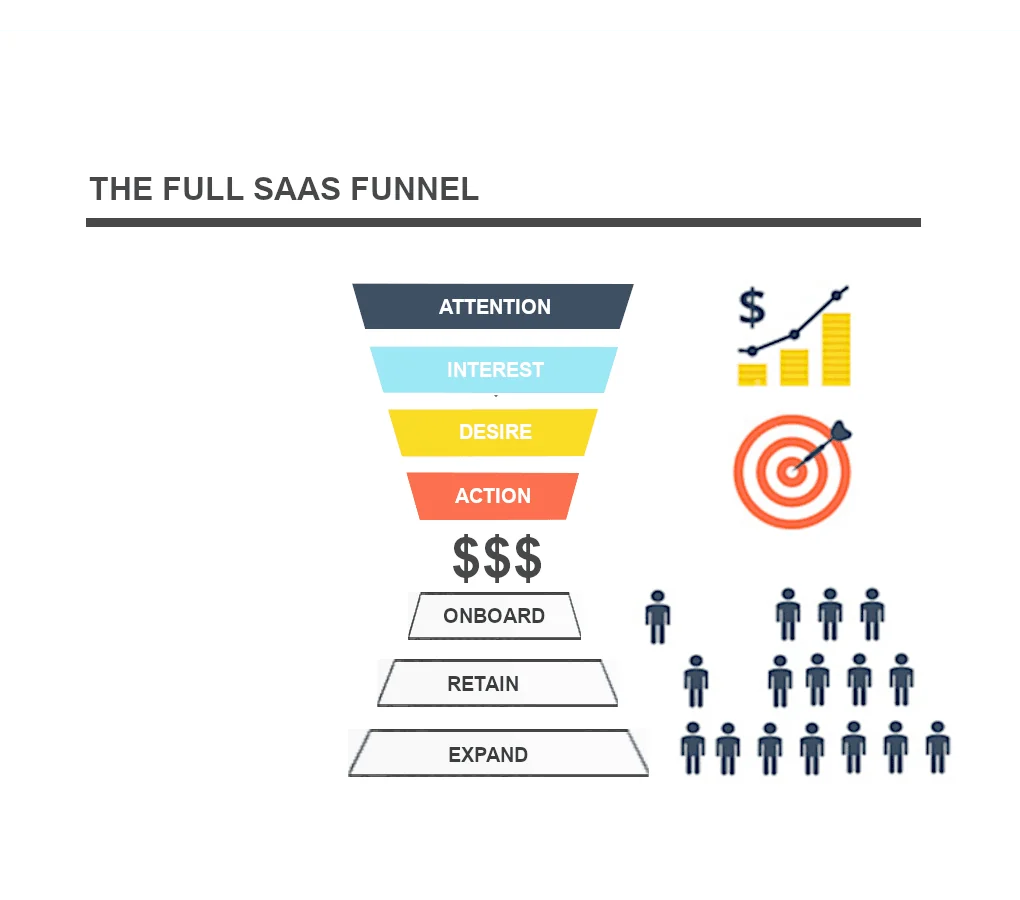
Typically, in fact, SaaS offers a trial period and a subscription model generating recurring revenues and frequent upsells for new features, add-ons and so on. The focus is therefore on the customer’s Life Time Value more than on the value of the single deal.
A sales process made up of different phases and roles
The choice of a digital platform starts first of all from knowing about it, or from a need of the company.
Building awareness, sustained by users’ trust in the solidity of the solution, is a costly, articulated process, but an indispensable one for scaling.
The need, or business pain, can be something urgent and mandatory (as happened with the arrival of electronic invoicing) or a need induced through a path of education on the advantages of digital transformation applied to the various company processes.
Let’s see, then, what the cornerstones of a winning strategy are.
Communication, media planning and conversion
The first ingredient of online selling is generating awareness and traffic from an interested audience.
Awareness also means originality and recognisability in communication, as well as knowing how to tell the advantages of adopting the platform in question.
Production quality standards today are extremely high. It is therefore wise to invest in videos and content in general made by professionals.
Where needed, it is also wise to involve specialists in the subject at hand, to gain authority.
Media planning can then carry the promotional content on the most suitable advertising and social channels, to reach the set goals.
This way we will be known, visible and searchable, obtaining visits to our website.
Here the acquisition process begins, typically passing through lead generation (an information request contact) or trial generation (a free trial period).
Marketing automation and onboarding
Contact and free trial are simple steps for the user to complete. Investing time and money to roll the solution out in the company is a different matter. That is why it is necessary to keep a certain frequency of contact with the prospect so that they complete the activation.
The design of the flows and of the related automatic communications takes into account the time axis (e.g. the sign-up date) and the user’s behaviour (e.g. entering the subscription payment method).
The implementation of these automatic flows happens with the help of one or more specific pieces of software, commonly known as CRMs or marketing platforms.
It is good practice to build communications (email, SMS or other) that feel personal, perhaps even referencing real people from the Sales team as senders who can be contacted back if further detail is needed.
The assignment of individual deals to a specific member of the sales team can be determined by factors such as deal size or country of origin, to make the most of every person’s qualities and maximise the chances of closing the sale.
Onboarding, that is, getting the account up and running, must be as linear and simple an experience as possible, one that can be completed across several sessions too.
Monitoring the progress of the configuration, identifying any “stalls” to act on, is a useful activity for the Sales team to secure the confirmation of the subscription and prevent the prospect from dropping off.
Sales and Customer Success
The Sales team’s intervention is still an important component for many companies, which expect a human interaction in starting and managing a collaboration.
However, it is wise to reduce classic negotiation to a minimum, in favour of a more consultative, technical-sales approach.
On the most important customers, when sustainable, it is advisable to add a Customer Success figure who can accompany the customer towards full adoption of the product, for the purposes of retention and of maximising ARR (Annual Recurring Revenue).
Customers thus feel heard, followed, and are willing to buy additional Premium support services which, besides raising satisfaction in using the product, represent a further revenue stream.
Data Analytics
Reporting and data analytics close the circle.
In SaaS sales we have a multitude of data available. It would be a crime not to turn it into information useful to the company’s growth.
Before implementing reporting systems, however, it is necessary to identify the KPIs to monitor, such as the trial-to-subscription conversion rate or the churn rate (the percentage of customers who leave us).
The next step is crossing the metrics coming from several sources, perhaps using a dashboarding system. You might discover, for example, that a certain marketing channel generates many contacts but little revenue, or that a certain country responds well to subscription conversion but suffers from a high churn rate.
To grow with a data-driven model, it will always be useful to keep an eye on trends or variations in these important indicators, intervening with A/B tests and surveys on the customer base, and to optimise every single piece of the offering.
Conclusions
Selling SaaS subscriptions is not an activity assigned to a salesperson, but a complex, orchestrated synergy of multiple professional skills.
The Sales team will indeed hold the responsibility for sales, but it cannot do without the supply of new prospects from marketing, the development of new features and the automation of the processes leading to order completion.
It is therefore fundamental to distribute roles and responsibilities for every phase of the sale, as well as to define procedures, run internal training and equip the teams with tools so that all the pieces compose the puzzle. This kind of setup lets you know exactly which knots to work on to make the whole process scale.
Startup Bakery is the Italian startup studio specialised in creating B2B SaaS companies with Artificial Intelligence. We offer aspiring Co-Founders the opportunity to develop a business idea. We create investment opportunities for Professional Investors. We help companies in their innovation process.