

Early stage | 2023 forecasts
Which innovation sectors are attracting the most early stage investment? Which ones, instead, are declining? Are the most talked-about sectors also the fastest growing? QuSeed, the software developed by Startup Bakery, has crossed financial data with conversational data, searching for the emerging sectors that are still talked about too little.
In an early stage market marked by a general decline, both in terms of startups founded and in the number of funding rounds and capital raised, Pollution Control, Affiliate Marketing and Quantum Computing lead the ranking of the fastest-growing sectors. Declining are Organic Food, Privacy and e-Learning.
Virtual Reality, Delivery and e-learning are on the podium with the most startups founded, the most capital raised and a higher popularity index.
Milan, 27 December 2022: What is the state of health of the early stage startup market? Which are the fastest-growing sectors and which the declining ones? Are the most talked-about sectors also the fastest growing? QuSeed, the software developed by Startup Bakery, the Startup Studio specialised in SaaS solutions with elements of AI, has crossed structured financial data with conversational data to offer a snapshot of the year just ended, sketch some forecasts for the one to come and provide reference examples for each sector.
Early-stage investment in decline
What immediately stands out is a general decline in the early-stage startup market.
In absolute terms, the number of startups founded and the number of funding rounds in 2022 are lower than in 2021: specifically, from 28,722 startups founded in 2021 the figure fell to 10,567 in 2022, marking a decrease of 63%, while as regards funding rounds the values fell from 31,706 in 2021 to 22,040 in 2022, tracing a decline of 30.5%. Finally, looking at how much was raised in the two years, the value fell from $238.4B in 2021 to $174.7B in 2022, a decrease of 26.7%.
“Why is it so important to look at the early stage startup market? Because it is the first moment in which investment meets innovation in the process of creating a company, and it is therefore a useful litmus test for identifying the most promising sectors in which the interest of specialised investors begins to show”, commented Angelo Cavallini, Founder & COO of Startup Bakery.
QuSeed is an always-on antenna that makes it possible to compare the investment and growth dynamics of early stage startups with the interest those sectors attract online, allowing the identification of sectors that are potentially “hot” but not yet popular with the wider public.
“QuSeed is also one of the instruments we refer to when we have to make investment decisions, that is, bring a new startup to life. Always having under control how and in which sectors the world of innovation is moving is for us an indispensable requirement in order to start the machine of business validation and move to the following phases”, added Cavallini.
Through the massive use of Artificial Intelligence, the QuSeed algorithm aims to provide the pulse of the Innovation market with a dual approach: it processes both investment data collected from Crunchbase and data on the resonance, in terms of sharing and engagement, of a specific theme within the most involved and active online communities, drawing on more than 5,000 international web sources.
Sectors: who is up and who is down
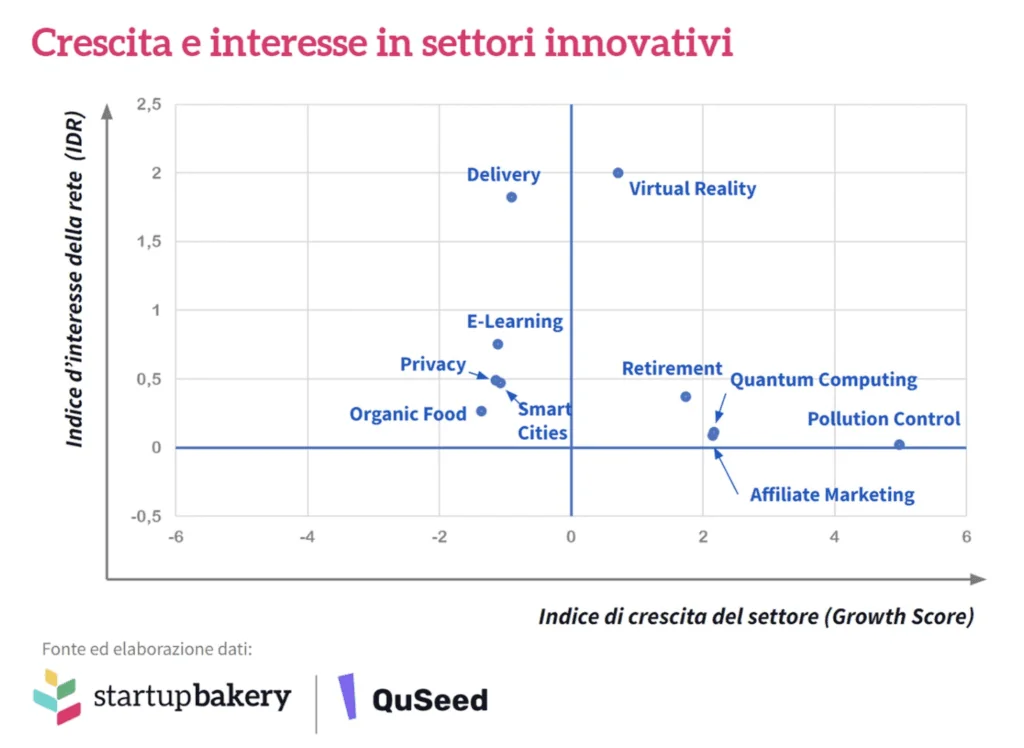
By analysing the parameters listed above and comparing the market share held by a given sector in 2022 with the one held in 2021, QuSeed recorded the fastest-growing and fastest-declining areas for 2022, assigning them a Growth Score and an IDR, Information Diffusion Rate (online interest index), *see methodological note.
At the top of the ranking of the fastest-growing sectors we find Pollution Control, Affiliate Marketing and Quantum Computing, with growth scores of 4.98, 2.17 and 2.15 respectively. The most declining are Organic Food (-1.36), Privacy (-1.14) and e-learning (-1.11).
E-learning, however, is the area holding the record for the number of startups founded (81) in 2022, followed by Virtual Reality (72) and Delivery (27). The same sectors are the ones that also raised the most capital: Delivery comes first ($1.28B), followed by e-learning ($1.14B) and Virtual Reality ($1.11B).
This podium is confirmed in terms of popularity too, with Virtual Reality leading the ranking of the most “discussed” sectors (with an IDR of 2), followed by Delivery with 1.82 and e-learning with 0.75. Delivery and e-learning, however, record a negative growth score and therefore a decline.
Retirement, in particular, shows good growth (growth score 1.74) and a positive IDR (0.37%), a sign of a healthy sector slowly gaining popularity. The Smart Cities area shows more or less the same IDR, but is characterised by a decline (growth score -1.07).
“This figure is perfectly in line with the investment decisions our startup studio has made regarding its third startup, Sencare, a platform for the digitisation of home care that has already raised €400K right after opening a €700K funding round a few days ago”, added Alessandro Arrigo, CEO of Startup Bakery.
So is there a correlation between the volume of investment in a given sector and the number of news items and conversations concerning it?
“One certainly cannot speak of correlation, even though an increase in conversation about a theme does lead investors to consider it, even if it was little known until then, concluded Angelo Cavallini and Alessandro Arrigo*, In some cases, as the matrix produced by QuSeed shows, there are sectors that are talked about a great deal yet record a decline, such as Delivery, perhaps due also to the end of lockdowns in 2022. Others are moderately growing but much discussed, such as Virtual Reality. Others still, such as Pollution Control, record a strong increase but remain under the radar in terms of ‘visibility’. Intercepting these sectors at the moment they hit the accelerator can buy a good margin of time and therefore a competitive advantage”.*

left: Angelo Cavallini, COO and co-founder of Startup Bakery; right: Alessandro Arrigo, CEO and co-founder of Startup Bakery
Startup Bakery
Startup Bakery is the Italian startup studio founded by Alessandro Arrigo and Angelo Cavallini in February 2020 with the goal of bringing to life sustainable B2B SaaS companies with a strong Artificial Intelligence component, and of allowing founders, companies and professional investors to express their potential.
The Studio guarantees the serial application of tools, skills and methodologies already present in the team, and stands beside the co-founder through every phase, from the raise to the exit, making them progressively more independent. Thanks to a proprietary algorithm, it can count on advanced capabilities for collecting and processing market data in order to identify niches of interest to occupy, while the cyclical validation of the initiatives launched is guaranteed by the application of the lean method.
The user-centred Interaction Design approach guaranteed by the know-how of Donux, the UX/UI company spun up by Startup Bakery itself, finally delivers simple, effective user experiences.
Startup Bakery offers industrial partners a new way of doing open innovation, entering the capital of the new startups and progressively accompanying them in their development up to acquiring them.
The SB “Labs”, the group’s operating companies, have the task of financially supporting the initiatives spun up in the pre-seed and seed phases (in co-investment), as well as building their core team (HR).
At the end of November 2020 Startup Bakery closed a capital increase of €750,000. In April 2021 it opened the €700,000 capital raise for its first startup, Veterly, and in October of the same year it brought it to market. In January 2022 it completed the €1,950,000 capital raise thanks to its first Lab. In March 2022 it presented its second spun-up startup, Condeo, for which it closed the €700,000 capital raise in October 2022, with Edison and Svicom among the main industrial partners.