


First of all, where are we today? I believe that as far as applied Artificial Intelligence goes, we are truly still just at the beginning. To give some more concrete reference points, I think we are still in the “Technology trigger” phase of the Gartner Hype Cycle, with mainly the “Innovators” group of Rogers’ Diffusion of Innovations theory still active.
How can that be? you will think. Ever since Mary Shelley and her Frankenstein’s Monster, the concept of intelligence created in a laboratory has permeated mainstream literature. How is it possible, then, that in more than 2 centuries we have not advanced in its adoption? Actually, it is possible, simply because today we can place the word “applied” next to “Artificial Intelligence”. And that makes all the difference in the world.

The (incomplete) democratisation of AI
I am not sure it is clear. We moved, as very often happens, from Science Fiction to applied Science, passing through decades of active, widespread research.
Research activity should not be understood as purely “technical”. That began in 1956 with the famous Dartmouth College seminar in Hanover. The Internet and, above all, the Cloud from 2010 onwards, instead, made it possible to unlock research on the business side too, finally making AI accessible to innovators.
I pride myself on belonging to this group of people since 2017, the year in which, together with my partner Fabrizio Milano d’Aragona, we gave shape to FinScience, exploring the first architectures and the first services available at the time (all far more expensive than today’s!). Artificial intelligence, though, was not among them. You had to build it yourself, at home. Piece by piece (library by library, when you were lucky).
That experience taught us how complex the research and grounding of even just a few Machine Learning algorithms was. Never mind venturing into the depths of Deep Tech! We had to give that up immediately, again because of the costs. Consider that after roughly a year and a half of research, together with my current partner Angelo Cavallini too, we had managed to stand up an infrastructure that cost 10 times less than those of many of the Big Data SaaS of the time.
Why am I telling this? Because even today, despite a sharp decrease in costs, anyone who wants to approach the Artificial Intelligence theme seriously must be prepared to pay for it. And with the entire industry still practically at its dawn, it will not be so accessible (even models that are now open source, like Llama, must then be implemented, activated and maintained).
Artificial Intelligence at Startup Bakery
Only those who have truly had their hands in the dough know how complex and costly the theme is. That is why, together with my partner Angelo, we decided from the start to make Startup Bakery the centralised AI research hub for all the startups in our group.
We research and select algorithms, libraries, projects, applications and services that make up a framework immediately ready and integrable into our B2B SaaS through a simple proprietary API layer.
And given the experience, we immediately and categorically ruled out betting on Deep Tech. Not because we would not like to (quite the opposite!), but because doing Deep Tech seriously requires truly vast funds. To be clear, we are talking millions at pre-seed and tens or hundreds at seed. Funds that would be hard for us to raise even at the centralised level, let alone for each startup!
The best way to always stay up to date on any topic that is not purely theoretical is to put it into practice: for this reason we also built a proprietary SaaS of our own, QuSeed. It is a valuable aid for monitoring the world of innovation. QuSeed in fact combines the structured data coming from investment rounds with the unstructured data coming from the world of news, and processes them with proprietary Artificial Intelligence algorithms. As output we get useful support in generating or validating business ideas, but above all a sandbox for experimenting with what’s new in AI.
The importance of data
A tip for those approaching the theme in these months: do not focus only on the output, but always start by selecting the best input given the output you would like to obtain.
All those who, like me, did consulting in the data field, as far back as 2012-2013, built slides showing the volumes of content produced per minute on the web for every platform. Even then, those slides were used to sell digital intelligence consulting, positioning data as “The new Oil”.
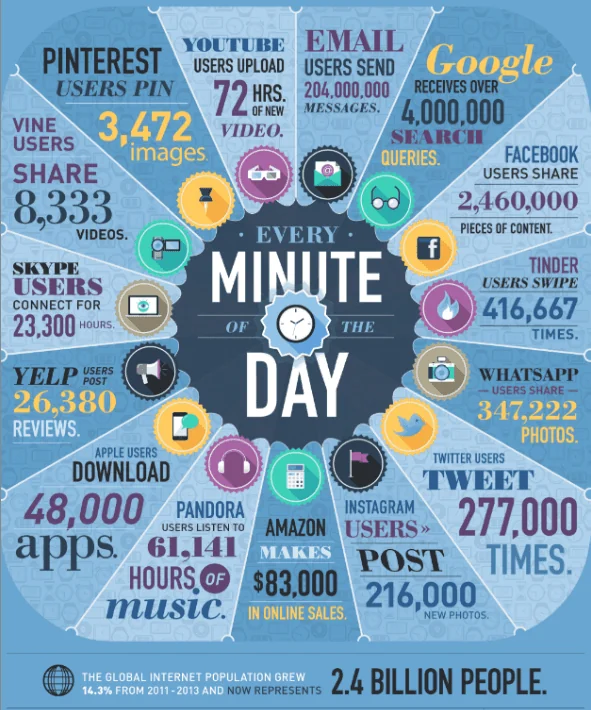
Artificial Intelligence has amplified the value of data, because without data it is useless. And with incorrect or “dirty” data it often proves harmful too. When, for example, you see the AI newbies online mocking ChatGPT’s output for returning incorrect information, the problem does not lie so much in the model’s stupidity or lack thereof, but very often in the model’s ability to acquire and process quality data.
As you will have understood, the learning curve of the dynamics of exploiting AI is truly steep.
Ready-to-use AI
In light of the above, how long do you think it would have taken our Condeo to develop, in-house, a model for the property manager enabling the automatic prioritisation of residents’ requests and reports, based on the content and tone of the messages?
And how long would it have taken even just to scout the right library or the best service to extend and integrate? Because if it is true that AI is ready to use, you must always know how to evaluate its performance.
Not all libraries or services are equal: some are more “precise” than others, but perhaps implementing a precise model pushes variable costs up too much, so second best solutions must be found, which in most cases means extending or customising existing solutions.
And then, a model that works well for Condeo will not necessarily work as well for Sencare, Veterly or ESGmax. Can you imagine why? Exactly. Always the data.
At Startup Bakery we constantly grind through a great quantity of scientific papers and try to replicate the results with real data before deciding which AI service is best for each use case. And this, if the team does not include at least one Data Scientist and one Data Engineer, is simply impossible.
It’s a kind of magic
Even with the right team, the work behind the simple use of “ready-to-use” Artificial Intelligence, like the various ChatGPT, Llama, Bard, Bert and so on, is considerable. The fact that for our startups it comes down to a simple API call makes it all look like a kind of magic.
We are, however, ever closer to the moment when AI will be truly useful (and not just available) to the wider group of Early Adopters too, because those tinkerers, the Innovators, have by now produced a great many use cases, which have made this world a bit more magical.
The more useful and applicable this magic becomes, the more we will talk about the “artificialisation” of industries, and no longer of mere “digitalisation”. For industries not yet digitalised, it is a concrete opportunity not just to close a gap, but to make a genuine evolutionary leap.
The near future
As a reader of Harari, my hope is that we do not overdo the evolution towards Homo Deus. Even though that evolution is already under way and will only be stoppable in the event of extremely unfavourable geopolitical scenarios.
Hoping, though, that everything stays more or less as it is now, 2024 will be the year in which the use cases consolidate and get applied by more and more companies and industries, probably through Open Innovation. From 2025 we should then witness the first culling of players who today try to ride the hype without truly having the skills, and later witness cyclical evolutionary “bursts” of Artificial Intelligence, ever closer together, requiring ever less time to prove their usefulness in concrete applications that improve the society we live in.
As you know, in fact, at Startup Bakery we have championed Sustainable Innovation since birth. And the innovation tied to the AI (and data) world is definitely an innovation that matters. To everyone. Since yesterday.
Startup Bakery is the Italian startup studio specialised in creating B2B SaaS companies with Artificial Intelligence. We offer aspiring Co-Founders the opportunity to develop a business idea. We create investment opportunities for Professional Investors. We help companies in their innovation process.