

In a previous article of ours, we took apart one of the most widespread myths in the startup world: the idea that automation is a luxury to postpone to “when we’re more structured”. We explained why the right moment to start is sooner than you think, precisely to protect the most precious resource of all: time.
But saying “do it now” is not enough. When you move from theory to operational practice, the question haunting every founder becomes: how do you actually do it, without breaking things?
We know there is an exact moment in a company’s growth when day-to-day management starts slipping out of hand. Customers increase, the team grows, and those dynamics that used to be solved out loud in the office or with a quick message on Slack or Teams end up turning into a labyrinth of lost emails and operational fog.
Instinct, at that point, pushes towards a shortcut: “Let’s buy a software and automate everything!”
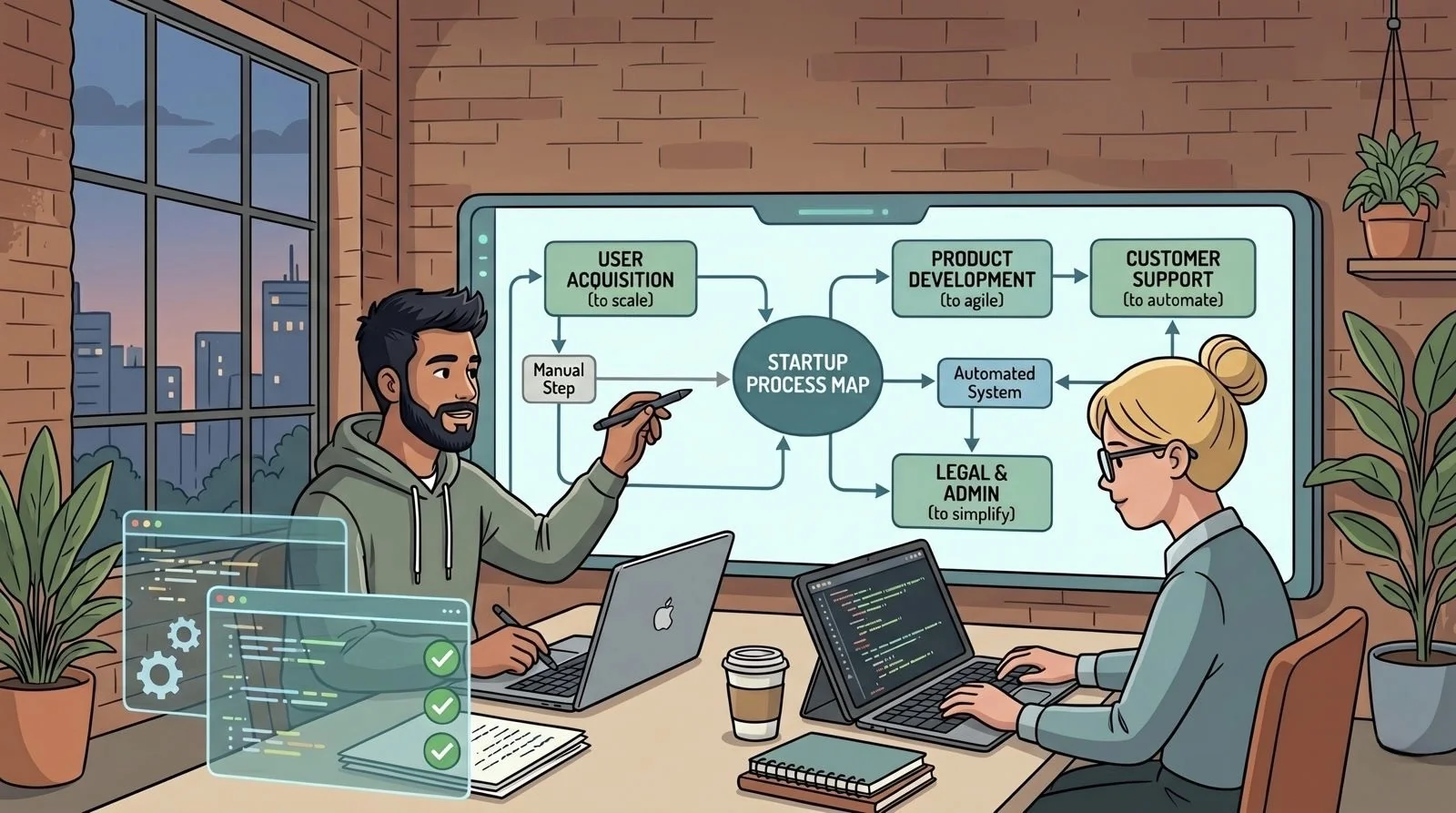
Better to stop for a moment. Automating a chaotic process very often means making the chaos travel faster. Before introducing a new tool or delegating to Artificial Intelligence, it is essential to understand exactly what is happening behind the scenes. Only then can you map the processes that absorb the most energy.
We are not talking about adding tedious corporate bureaucracy, but about securing real operational survival.
Here is how we believe this step should be handled in practice, always keeping the focus on people.
1. Mapping: where do you start, operationally?
Mapping a process does not require writing an endless manual. Often a whiteboard, physical or digital, is enough to visualise the path of an activity from point A to point B.
The secret is to ask three key questions for every single operation:
What is the trigger?
Who does what, and with which tool?
How much time does that activity take?
What is the expected output?
A practical example: Customer Onboarding
Instead of having a team chasing each other to figure out whether a customer has paid or who should send the materials, it is far more useful to draw the flow on visual, accessible tools, the best known being Miro or Excalidraw.
Phase 1 (Manual reconnaissance): Drawing the steps with digital post-its, the “grey areas” will emerge immediately, those steps that exist only in habit or in the memory of a single team member.
Phase 2 (Simplification): Before automating, it is wise to streamline. Do you really need three different tools to exchange a document? Maybe moving to a shared space on Notion or Trello is enough.
Phase 3 (Basic automation): Once the flow is clean, you can introduce no-code tools with free or accessible plans such as Make (of which we at Startup Bakery are official Partners) or n8n.
The result: When the quote is signed digitally, Make automatically creates the customer folder on Google Drive, opens a task on Notion for the technical team and sends a message on Slack or Teams to notify everyone of the new contract. No more manual steps or copy-pasting.
2. Beyond text: using AI to structure operational thinking
Artificial Intelligence is not just a tool for generating text or images: it can prove an excellent ally for structuring operational thinking.
If you are unsure where to start the mapping, platforms like ChatGPT, Claude or Gemini can act as actual consultants. You can try a prompt like this:
“I am the founder of a B2B startup. I need to map the handover process between the Sales team (which closed the contract) and the Operations team (which has to deliver the service). What are the fundamental steps I cannot forget? Create an operational checklist for me.”
The AI will provide a logical starting base, helping you get past blank-page syndrome. You can also integrate AI directly into the flows to handle unstructured data. An interesting use case is having the AI read the scattered notes of a sales call and asking it to automatically fill in the customer’s record on the CRM, neatly.
This is an approach we believe in deeply: we too, in Startup Bakery’s operations, use AI every day, relying on a squad of agents to best manage and scale these organisational aspects.
3. The Human Factor: automation does not replace dialogue
One of the most common missteps for those leading a company is dropping an automation from above without properly involving the team.
If processes rest on software, companies are founded on people. When you decide to map a flow, doing it isolated in your office is counterproductive. It becomes essential to sit next to the people who handle the operations every day.
Asking questions like: “In which phase do you feel you lose the most time?” or “What is the manual activity you find most frustrating?” changes the perspective completely.
Team members often look at automation or AI with a certain distrust, fearing it might threaten their role. The job of a good leader is to transform this narrative. Automating the transfer of data from a form to an Excel sheet is not meant to replace the person who handled it, but to free up their time. This way, people can dedicate themselves to what a machine cannot replicate: nurturing the customer relationship, solving complex problems and bringing creative thinking.
4. The right moment to automate
Always remember that the time factor and ROI (Return on Investment) apply to automations too. Not everything has to move to software:
Keep manual: what happens rarely or requires a strong human, personalised touch.
Automate: what is repetitive, drains the team’s energy, takes hours away from you every week and causes trivial bottlenecks.
Automation is not the cure for chaos, but the amplifier of a healthy system. Bring order with your team, choose light tools and let technology do the “dirty work”. The real luxury of a well-automated startup is taking back the time to think.
###
Startup Bakery is the Italian startup studio specialised in creating B2B SaaS companies with Artificial Intelligence. We offer aspiring Co-Founders the opportunity to develop a business idea. We create investment opportunities for Professional Investors. We help companies in their innovation process.